Australia is a global leader in rooftop solar energy, with over 4.2 million rooftop photovoltaic (PV) systems installed to date. In stark contrast, however, the penetration rate of energy storage facilities remains extremely low—prior to the implementation of relevant subsidy policies, only 1 out of every 40 households had an energy storage battery installed. Prohibitive upfront costs have deterred numerous households and businesses from investing in energy storage equipment. To address this bottleneck, the federal government launched the Cheaper Home Batteries Program, leveraging fiscal subsidies to stimulate the residential energy storage market.
Initially allocated a budget of A$2.3 billion, the program offers a discount of approximately 30% on upfront costs for households, businesses, and community organizations installing small-scale battery systems with capacities ranging from 5kWh to 100kWh. Following its launch, the market experienced explosive growth. Official and industry data indicate that within just 10 weeks of the program’s implementation, over 50,000 energy storage batteries were installed across Australia, representing a sharp surge in newly installed capacity. However, this rapid expansion also gave rise to issues such as blind capacity expansion, underutilization of equipment, and cutthroat competition.
In response, on December 13, 2025, Australian Federal Energy Minister Chris Bowen announced a major update: in the mid-term budget revision, the subsidy pool for residential energy storage will be increased from the initial A$2.3 billion to A$7.2 billion. While expanding the budget, the government has also introduced structural adjustments to subsidy rules, directly targeting the problem of excessive and rapid budget depletion. According to the Department of Energy, under the new rules, subsidies for high-capacity energy storage systems will be significantly reduced—in some cases, even halved.
Effective May 1, 2026, the previous policy of full subsidies for systems ≤50kWh will be replaced by a tiered subsidy structure: · 0–14kWh: Full subsidy · 14–28kWh: 60% of the original subsidy rate · 28–50kWh: Only 15% of the original subsidy rate
For example, a 48kWh battery that currently qualifies for approximately A$15,840 in subsidies will receive only around A$8,382 under the new rules. Notably, subsidies for household-friendly system capacities of 14kWh and below will remain unchanged. This adjustment will effectively eliminate irrational configurations such as "6kWh inverters paired with 50kWh batteries"—a case of "a small horse pulling a large cart"—and guide consumers to select battery capacities that match their actual electricity consumption needs.
Energy storage systems with capacities of 14kWh and below are poised to become the market mainstream. These products not only align with daily household electricity demand but also qualify for full subsidies. KOYOE’s 8kWh and 12kWh single-phase stackable energy storage systems are perfectly tailored to this market demand. Moreover, these products have obtained certification from the Clean Energy Council (CEC), ensuring compliance with quality standards and regulatory requirements. 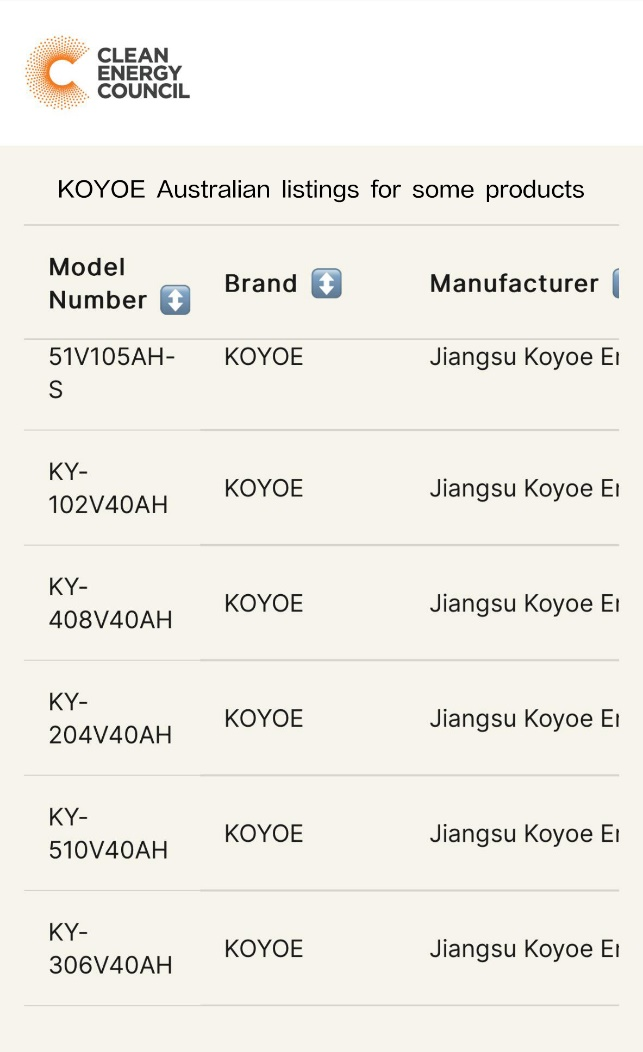
Australia Site A.N.E Technical Helpline: 0416 359 989 / 0412 011 720 Marketing Team: 0433 980 414
Website: https://mall.koyoe.com/ In terms of performance, KOYOE’s stackable systems boast prominent advantages: · Intelligent Switching Function: Supports off-grid operation with seamless grid-to-off-grid and off-grid-to-grid switching, ensuring uninterrupted power supply during outages. · High-Efficiency Power Generation: Minimal power derating in high-temperature environments for enhanced energy conversion efficiency; with a DC oversizing capability of 1.7 times, it maximizes the utilization of solar energy resources. · Modular Design: Features stackable, easy-to-install components with a sleek appearance that seamlessly integrates into modern home aesthetics. · Wide Voltage Compatibility: Offers an ultra-wide PV input voltage range (80V–500V) and battery voltage range (85V–450V), ensuring strong compatibility with diverse system configurations. 
(Taking KOYOE’s 12kWh stackable energy storage system as an example) This combined strategy of budget expansion paired with stricter rules will exert a profound impact on Australia’s residential energy storage market—it not only sustains the growth dividend but also drives the industry toward high-quality development. In terms of market scale, the A$7.2 billion subsidy pool is expected to leverage approximately A$24 billion (equivalent to around RMB 112 billion) in total market investment, indicating that Australia’s residential energy storage boom will continue for another four years, presenting significant opportunities for global energy storage enterprises.
In the long run, the policy adjustment will shift Australia’s residential energy storage market from a scale-focused model to a quality-focused one. Throughout this transition, the policy governance framework will provide a solid foundation for stable market development:The Department of Energy, as the policy-making authority, is responsible for purchasing Small-scale Technology Certificates (STCs) and monitoring policy implementation.The Clean Energy Regulator (CER), as the implementing body, manages the Small-scale Renewable Energy Scheme (SRES) through a risk and compliance framework, enforcing product standards, installer certification requirements, and inspection programs.
The two authorities collaborate via an inter-agency steering committee, and work in conjunction with the Standards Australia (SAA), the Clean Energy Council (CEC), and local electrical safety regulators to ensure the safety of products and installations.
Backed by the A$7.2 billion subsidy budget and a mature regulatory system, subsidies will continue to drive the penetration rate of energy storage systems. This will not only help households reduce electricity bills but also provide the power grid with abundant distributed regulation resources, enhancing the stability and resilience of the energy system. Furthermore, the deep participation of the global supply chain will further drive technological upgrades and cost reductions, enabling Australia’s energy transition to advance steadily and sustainably. |


