Entering 2026, with the national-level clarification of the capacity electricity pricing mechanism for grid-side independent energy storage, the revenue structure of the energy storage industry is undergoing a systemic transformation. As of March, nine provinces have issued specific implementation plans, providing a predictable compensation channel for independent energy storage stations. Based on the latest policy documents, this article outlines the access conditions, regional differences, and operational key points of this mechanism. I. Policy Framework: Three Types of Access Conditions Establish Compensation Thresholds In January, the National Development and Reform Commission (NDRC) and the National Energy Administration (NEA) issued the "Notice on Improving the Capacity Electricity Pricing Mechanism for the Generation Side" (NDRC Price [2026] No. 114), clarifying for the first time at the national level the capacity pricing mechanism for grid-side independent new-type energy storage. The document stipulates three basic types of access conditions: · Functional Positioning: Projects must serve the safe operation of the power system and be grid-side energy storage facilities under independent dispatch and independent metering. "Allocation storage" projects supporting new energy stations are not included in the compensation scope. · List Management: Projects must be included in the official implementation list by the provincial energy authority in conjunction with the price authority; projects not included in the list are not eligible for compensation. · Technical Conversion: The capacity electricity price is based on the local coal power capacity electricity price and is converted according to the ratio of the storage's full-power continuous discharge duration to the longest net load peak duration throughout the year. The stronger the discharge capability, the higher the compensation ratio. II. Regional Practices: Comparison of Compensation Models in 9 Provinces Currently, nine provinces – Hubei, Gansu, Ningxia, Hebei, Inner Mongolia, Guangdong, Zhejiang, Shandong, and Xinjiang – have issued detailed implementation rules. Based on the compensation logic, they can be divided into the following three categories: 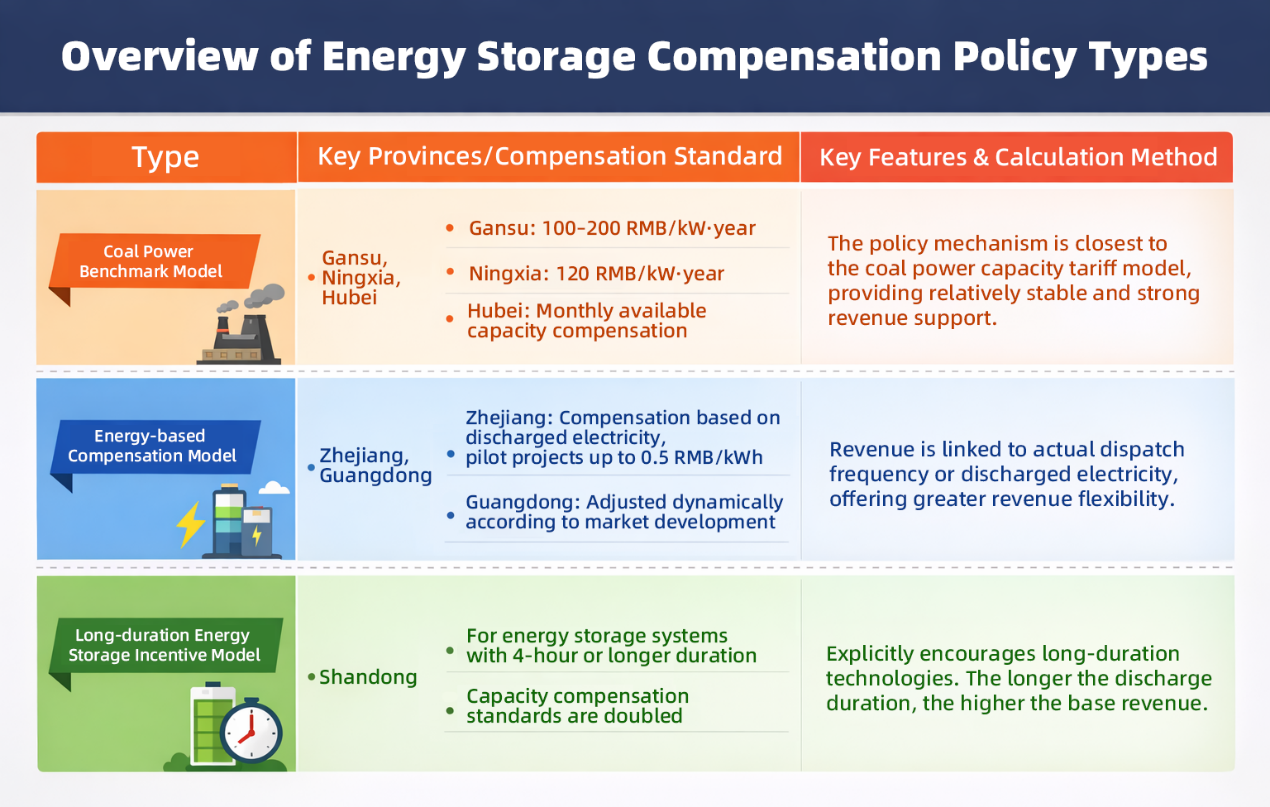
III. Trends and Risks: Policy Diffusion and Rising Operational Requirements From the policies issued by the nine provinces, the industry exhibits the following development characteristics: · Expanding Policy Coverage: It is expected that in the second half of 2026, more provinces will issue local rules referencing Document No. 114. Capacity compensation is likely to become a common source of revenue for grid-side independent storage. · Clear Technology Orientation: Policies like Shandong's double compensation for long-duration storage reflect the system's demand for resources with long discharge durations, potentially guiding investment towards projects with durations of 4 hours or longer. · Refined Assessment Mechanisms: As the number of projects increases, assessment standards for operational performance will gradually become more detailed. A project's actual output capability and dispatch response level will directly impact its revenue level. Simultaneously, two potential risks exist: · Potential Compensation Phase-Out: Policy documents from provinces like Zhejiang and Guangdong indicate that capacity compensation might have a "pilot period" or "annual decrease" arrangement. Project revenue projections need to account for long-term policy adjustment factors. · Increased Operational Requirements: The introduction of assessment indicators such as availability rate and output during peak periods requires project owners to possess real-time monitoring and dispatch optimization capabilities. Relying solely on policies to obtain revenue is no longer a sustainable model. The implementation of the capacity pricing mechanism has established a compensation channel for grid-side independent storage that is linked to system needs. For project investors, the current stage requires focus on three key tasks: First, confirm project access conditions based on provincial detailed rules. Second, establish an operational management system that meets assessment requirements. Third, comprehensively consider diversified income from capacity compensation, the electricity energy market, and the ancillary services market in revenue projections. As policies gradually improve, the revenue structure for energy storage projects will become more diversified, and the importance of operational capabilities will continue to increase. |


